Status of juvenile salmon in Wester Ross 2025 report published
Posted: Friday 6 March, 2026 @ 11:19:16
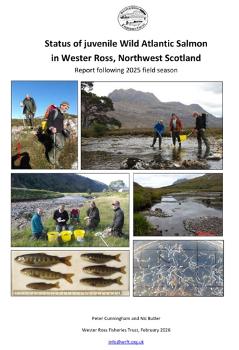
This report provides a summary of the results of a survey of juvenile salmon in the Wester Ross area in July – November 2025 (with some data from 2024 also referred to). Over 100 sites were surveyed in 15 river systems during this period using specially designed electro-fishing equipment.
Healthy numbers of juvenile salmon were recorded in major rivers flowing into the Wester Ross Marine Protected Area [WR MPA] including the rivers Kanaird (Canaird), Ullapool, Broom, Dundonnell, Gruinard and Ewe. Healthy numbers of juvenile salmon were also recorded in the Badachro River. In contrast, to the south of Loch Gairloch (rivers Torridon, Balgy and Applecross), wild salmon populations remain fragile. No sites were surveyed in the Little Gruinard River or in the River Kerry in 2025.
There was evidence of contraction in the range of Atlantic salmon within parts of Wester Ross.
In 2024, no juvenile salmon were recorded in the Cuaig River (near Applecross). In 2025, salmon fry (young of the year) were not found in the upper River Kanaird above the Langwell falls; in the Allt na Coille (Tournaig) above the lower falls, in the River Bruachaig above the lower falls; in large parts of the River Balgy headwaters; in the Sand River (near Gairloch). This follows the lowest reported rod catch of salmon in the Wester Ross area on record in 2024. In previous years, juvenile salmon have been recorded in all these streams.
In contrast, in November 2024 salmon fry were found in the headwaters of the Abhainn Loch an Nid at the top of the Gruinard River system, a good result.
Our results generally concur with the Scottish Government’s proposed conservation gradings (based on reported rod catches) of salmon rivers for 2026 (see: Summary information on preceding page). They also support the contention that wild salmon populations, especially those in the south of the area associated with post-smolt migration routes that pass through Loch Torridon and the Inner Sound between Raasay and the Scottish mainland, are particularly vulnerable to high cumulative emissions of larval sea lice from nearby salmon farms. The nearest salmon farms to this migration route are in the east of Skye, Loch Kishorn, Loch Carron and Loch Torridon, where sea lice need to be more tightly controlled. It is in these areas that wild salmon populations are at greatest threat of being damaged further or being lost in terms of retaining any river-specific genetic adaptations.
The upper Bruachaig River (River Ewe headwaters) remains the largest area of freshwater habitat within the Wester Ross area where juvenile salmon production could be much higher than it has been in recent years. Other river systems where actions are needed to support wild salmon populations include parts of the rivers Kanaird, Torridon, Balgy and Applecross.
The production of wild salmon smolts from some rivers could be higher with greater attention to the protection and restoration of riparian habitat (e.g. alder and other riverside trees), revival of vegetation and biodiversity within catchment areas including restoration of fertility (e.g. addressing phosphorus deficits) at ecosystem scale. Some landowners are taking remedial actions to restore or enhance riparian woodlands (e.g. Torridon and Balgy river catchment areas) and there are plans for riparian woodland restoration projects along several other stream systems to provide shade and restore habitat and enhance nutrition for juvenile salmon.
Electro-fishing surveys were carried out under contract for hydropower schemes, to inform Environment Management Plans [EMPs] for local salmon farms, as part of the Salmon Stream Nutrient Restoration pilot project (funded by HIEF), or were supported by the Wester Ross Area Salmon Fishery Board [WRASFB].
The report can be found here
Thank you to all funders and to many estates and other helpers for their support in 2024 and 2025.


